


If your clinic is choosing between diode laser and IPL, the answer is not simply “diode is better.” Both technologies can reduce unwanted hair. The better choice depends on your clients, treatment volume, service menu, and business model.
For a clinic focused mainly on hair removal, a diode laser is usually the more specialized option. It uses a defined laser wavelength, or a controlled mix of wavelengths, to target melanin in the hair follicles. IPL uses broad spectrum light and filters. This gives IPL more flexibility for different light-based treatments, but it is less specialized for hair removal.
Both methods can provide long-term or permanent hair reduction. Neither should be treated as a guarantee of permanent hair removal.
Diode Laser vs IPL: Quick Comparison
| Factor | Diode Laser | IPL |
|---|---|---|
| Light source | Laser light at specific wavelengths | Broad spectrum light filtered into a usable range |
| Main target | Melanin in hair follicles | Melanin in hair and other skin targets |
| Hair reduction | Strong option for professional hair removal | Can also provide effective hair reduction |
| Skin types | Depends on wavelength and treatment parameters | Depends strongly on filters, energy, and skin pigmentation |
| Comfort | Depends on energy delivery and cooling system | Depends on device settings and cooling |
| Best business fit | Clinics with a strong hair removal business | Clinics that want one platform for several light-based services |
The main difference is how the light energy is delivered.
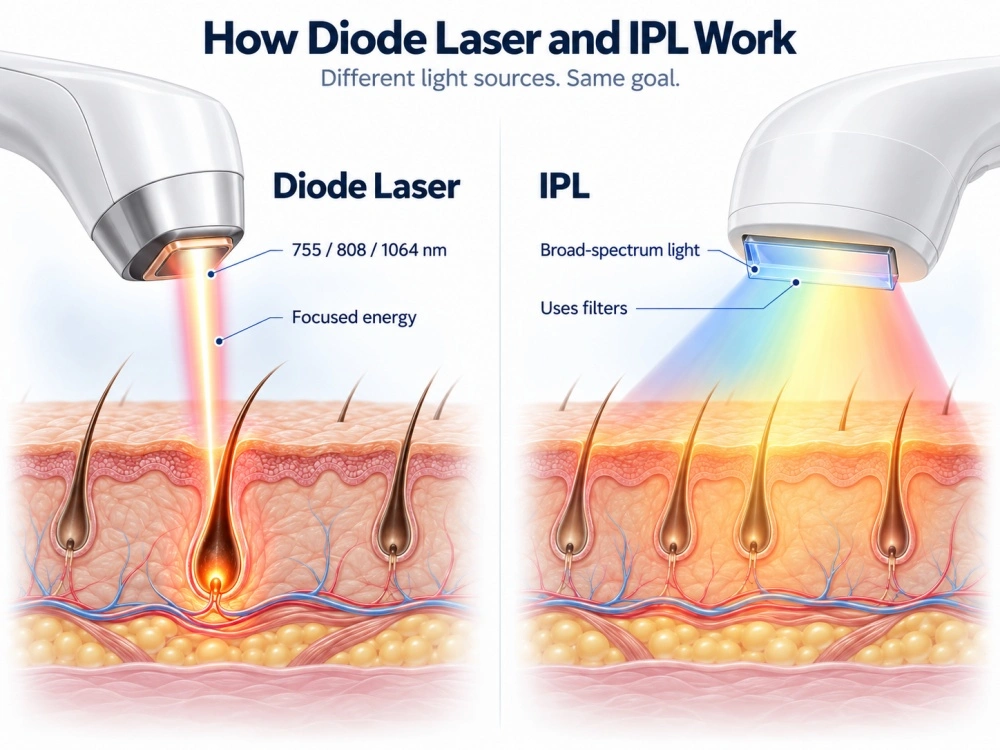
In diode laser hair removal, the device sends laser energy at a specific wavelength. 810 nm is common in clinical studies. Many current systems use 808 nm. Some professional diode platforms also combine wavelengths such as 755, 808, and 1064 nm.
The goal is to deliver light that can be absorbed by the melanin around the hair. That energy becomes heat and damages the structures that support future hair growth.
IPL hair removal works differently. IPL stands for intense pulsed light. It is not a laser. An IPL device produces a wider range of wavelengths. Filters are then used to shape that light for the treatment.
Both methods use selective absorption to target hair, but the light source and energy delivery are different.
For a deeper look at the technology, see our guide on how diode laser hair removal works.
Diode Laser vs IPL: Which Is More Effective for Hair Reduction?
Clinical evidence does not show that diode always beats IPL.
A 2026 study by Barros et al. compared an 810 nm diode laser with IPL for underarm hair removal in Fitzpatrick skin types I–IV. Four weeks after the fourth treatment, the intention-to-treat analysis found no significant difference in hair counts.
The per-protocol analysis showed a different result. Median hair reduction was 87.5% with diode and 76.6% with IPL (p=0.001, n=28). At the 30-week follow-up, the reported median reduction was 96.0% with diode and 77.9% with IPL (n=20).
The study also had limits. It only treated underarms, used a fixed 25 J/cm² setting, included Fitzpatrick skin types I–IV, and was stopped early.
For clinic buyers, the takeaway is simple: both technologies can work. Some longer-term data favor diode, but results still depend on the device, wavelength, settings, cooling, and treatment protocol.
Which Works Better for Different Skin Types?
Skin type matters because melanin is also present in the skin. The treatment needs enough light energy to reach the hair follicles without adding too much heat to the surrounding tissue.
This becomes more important with darker skin tones. More skin pigmentation means more melanin can absorb the light before it reaches the hair.
That is why wavelength and treatment parameters matter.
As a simple guide:
- 755 nm has strong melanin absorption and is often used for lighter skin and dark hair.
- 808–810 nm offers a balance between melanin absorption and penetration depth.
- 1064 nm is a longer wavelength with lower melanin absorption in the epidermis. This can make it useful when treating darker skin.

DermNet also notes that melanin can act as a competing target in darker skin. Longer wavelengths can reduce this competition and lower the risk of epidermal injury.
This does not mean one diode laser is automatically safe for every skin type. The wavelength, energy, pulse duration, cooling, and operator settings still matter.
Modern diode platforms may offer more than one wavelength. This gives a clinic more flexibility when treating different skin types and hair types.
IPL works differently. Its broad spectrum light is controlled with filters. The correct filter and energy settings become especially important as skin pigmentation increases. IPL can still be used on a range of clients, but darker skin usually requires more careful parameter selection.
Tanned skin also needs extra caution with either technology because more melanin is present in the epidermis.
Hair color matters too. Dark hair usually responds better because it contains more melanin. Light-colored hair has less pigment to absorb the energy, so both laser and IPL hair removal can be less effective.
If you want to compare these systems with other technologies, see our guide to the types of laser hair removal machines.
Pain and Cooling System: Which Is More Comfortable?
There is no honest answer that says diode laser is always less painful than IPL.
Head-to-head studies have reported different results. Some found diode treatment more painful. Others found IPL more painful.
The reason is simple. Pain depends on more than the name of the technology.
Energy level, pulse duration, treatment method, skin type, and cooling all affect comfort.
A good cooling system helps manage heat at the skin surface. Contact cooling can also allow the operator to deliver treatment while keeping the epidermis more comfortable.
This is why buyers should look beyond claims such as “painless hair removal.” Ask how the device controls heat during treatment. Also ask whether cooling remains stable during long treatment sessions.
Treatment Speed and Clinic Workflow
Treatment speed is also not determined by diode vs IPL alone.
Spot size, repetition rate, energy settings, treatment area, and delivery method all affect how quickly a session can be completed.
One study using the same 810 nm diode device compared two delivery methods. A 10 Hz in-motion method had a median treatment time of 20 minutes, compared with 26 minutes for a higher-energy static method. Pain was also lower with the faster method.
That study did not compare diode with IPL, so the numbers should not be used as a general diode-versus-IPL speed claim. It does show something important for a clinic buyer:
workflow depends heavily on device design.
A professional clinic should therefore compare more than wavelength. Repetition rate, spot size, cooling, handpiece design, and usable treatment parameters can all affect how many clients the business can treat in a day.
Cost and Total Cost of Ownership
Purchase price is only one part of the decision.

When comparing diode laser vs IPL, clinics should also look at consumables, maintenance, handpiece life, cooling, warranty, and downtime.
IPL systems use flashlamps. These are wear items and need replacement over time. Published market data shows a very wide range for lamp life and replacement cost. That is why there is no useful single “average IPL lamp cost.”
Diode systems have a different cost pattern. The laser bars and handpiece also age with use. Replacement is usually less frequent, but the cost can be higher when a major component needs service.
Cooling design can change operating costs too. Some contact-cooling systems do not require a cooling consumable for each treatment. Other systems use refrigerant that must be replaced.
So do not compare two machines by purchase price alone. Our laser hair removal machine cost guide explains the wider costs that clinics should check before buying.
When Does IPL Make Sense for Your Business?
IPL can be a good business choice for a clinic that wants one device for several services.
Hair removal may be only part of the treatment menu. The same IPL platform may also support selected vascular, pigmentation, acne, or photorejuvenation treatments. The evidence is not equally strong for every IPL application, but its wider treatment range is a real advantage for multi-service clinics.
This can make IPL attractive when:
- hair removal is not your main service;
- you want to expand several light-based treatments from one platform;
- treatment volume is still relatively low;
- a flexible service menu matters more than a dedicated hair removal workflow.
In this case, versatility may be more important than specialization.
When Does a Diode Laser Make More Sense?
A diode laser makes more sense when hair removal is a major part of your clinic business.
Some clinics start with IPL because they want one machine for several services. As hair removal demand grows, they may need a system built specifically for that job.
A dedicated diode system focuses on the features that matter every day: spot size, repetition rate, cooling, treatment settings, and handpiece life. This can make a busy hair removal schedule easier to manage.
That does not mean every diode laser will outperform every IPL system. Both can work well. The main advantage of diode is specialization.
If your clinic expects a high volume of hair removal treatments, compare professional laser hair removal machines by workflow, cooling stability, wavelength options, service support, and long-term ownership cost.
Where Does Hair Nova V2 Fit?
For clinics that want a dedicated diode laser hair removal machine, Hair Nova V2 offers a strong price-to-specification value for professional hair removal.
It combines 755, 808, and 1064 nm wavelengths. The featured configuration uses an 1800W handpiece, a 12×36 mm spot size, and a 1–10 Hz repetition rate. This gives clinics the flexibility to handle different treatment areas and busy daily schedules.
V2 also uses sapphire contact cooling that can reach -32°C. Its handpiece is designed for up to 100 million shots. For clinics with regular hair removal volume, these features can help support comfort, treatment efficiency, and long-term use.
Because V2 is supplied factory-direct by MLKJ, clinics can also get warranty coverage, lifetime training, spare-parts support, and fast after-sales response without relying only on a local distributor.
MLKJ also supplies regulatory and quality documentation across its hair removal product range. Depending on the model and destination market, this may include FDA 510(k) clearance, Health Canada MDL, CSA, CE/MDR, ISO 13485, and MDSAP documentation. Buyers should confirm the exact documentation available for the specific machine before ordering.

Diode Laser or IPL: Which Should Your Clinic Choose?
Choose based on your business, not on one marketing claim.
If your clinic wants one platform for several light-based services, IPL may be the better fit.
If professional hair removal is a core service, a diode platform usually offers a more focused workflow.
Before buying, compare the clients you treat, expected treatment volume, wavelengths, cooling, device life, consumables, service support, and total cost of ownership.
That will tell you much more than simply asking whether diode laser or IPL is “better.”
Still unsure which technology fits your clinic?
Contact the MLKJ team for a free consultation. We’ll help you compare IPL and Hair Nova V2 based on your treatment volume, services, and budget.
FAQs
Is diode laser better than IPL for hair removal?
Not always. Both can provide effective hair reduction. For clinics focused mainly on hair removal, diode laser is often the more specialized choice.
What are the downsides of diode laser hair removal?
Diode systems are more specialized and may have a higher upfront cost than some IPL machines. Comfort also depends on energy settings, treatment method, and cooling.
What are the downsides of IPL hair removal?
IPL is less specialized for hair removal and uses flashlamps that wear out over time. Treatment on darker skin also requires careful filter and energy settings.
Is diode laser the best for hair removal?
Diode laser is a strong choice when hair removal is a core service. IPL may make more sense if your clinic wants one platform for several light-based treatments.
Is diode laser or IPL better for darker skin tones?
Diode platforms with suitable longer wavelengths and adjustable parameters can offer more flexibility for darker skin. Careful settings are still essential with either technology.
Which is more painful, diode laser or IPL?
There is no clear winner. Studies have reported different results because pain depends heavily on energy, pulse delivery, cooling, and the treatment area.
How many sessions are needed for diode laser vs IPL?
There is no fixed number that applies to every client. Hair type, skin type, treatment area, hair growth cycle, device settings, and treatment response all affect the number of sessions needed.
How much does the Hair Nova V2 diode laser cost?
Hair Nova V2 typically costs about US$5,500–8,500 factory-direct, depending on the configuration. Shipping, destination requirements, and optional features can also affect the final quote.