


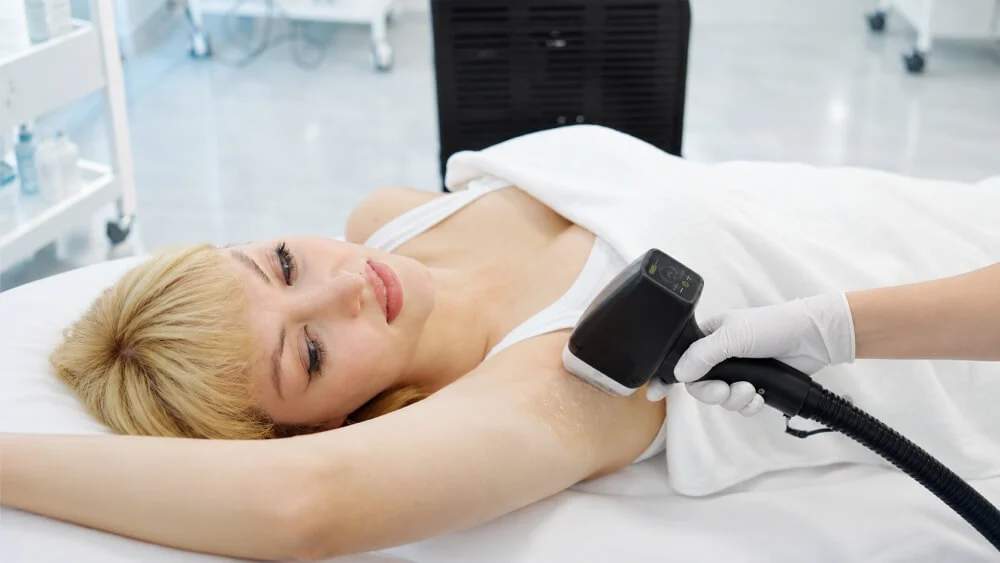
Diode and Alexandrite lasers can both deliver strong hair reduction. Neither is the clear winner in every clinic.
For buyers, the better choice depends on more than wavelength. Skin tone, hair type, cooling, spot size, treatment speed, service support, and cost all matter.
MLKJ builds diode laser systems, including Hair Nova V2. Later in this guide, we’ll show where a multi-wavelength diode platform fits and where Alexandrite may still make more sense.
Diode Laser vs Alexandrite: Quick Comparison
| Feature | Diode Laser | Alexandrite Laser |
|---|---|---|
| Typical wavelength | 800–810 nm | Around 755 nm |
| Laser source | Semiconductor diode | Alexandrite crystal |
| Common use | Professional hair removal | Professional hair removal |
| Lighter skin tones | Effective | Commonly used |
| Darker skin tones | Can be used with the right settings and cooling | Requires more caution as skin pigmentation increases |
| Dark, coarse hair | Good target | Good target |
| Cooling | Depends on the device | Depends on the device |
| Treatment speed | Depends on spot size, repetition rate, and system design | Depends on spot size, repetition rate, and system design |
| Clinical results | Strong | Strong |
| Clear winner in head-to-head studies? | No | No |
The biggest mistake is choosing a laser by wavelength alone. Two systems can use similar wavelengths and still feel very different in daily clinic work.

755 nm Alexandrite vs 808 nm Diode: What’s the Difference?
An Alexandrite laser usually works around 755 nm. A diode laser commonly works around 800–810 nm, with 808 nm being one of the most common wavelengths used in hair removal.
Both technologies target melanin in the hair follicle. The goal is to heat the follicle while limiting damage to the surrounding skin.
If you want a closer look at the treatment process, our guide explains how diode laser hair removal works step by step.
The shorter Alexandrite wavelength has stronger melanin absorption. That is one reason Alexandrite laser hair removal is widely used on lighter skin tones with dark hair.
The longer diode wavelength offers deeper penetration and is also widely used for professional laser hair removal. But skin tone alone should never decide the machine. Cooling systems, pulse settings, spot size, and operator technique also affect safety and comfort.
Clinics comparing professional laser hair removal machines should look at the full system, not just the wavelength printed on the spec sheet.
What Do Clinical Studies Show About Diode vs Alexandrite Effectiveness?
The strongest head-to-head research does not show a consistent winner.
In one 18-month within-patient comparison by Grunewald et al. (2014), patients received six treatments with an 808 nm diode laser on one side and a 755 nm Alexandrite laser on the other.
Hair reduction after six treatments was 72.16% with diode and 71.30% with Alexandrite. At 18 months, the reported reduction was 73.71% and 71.90%. The difference between the two systems was not statistically significant.

A 2022 systematic review by Krasniqi et al. found that long-term hair reduction varied widely from one study to another for both diode and Alexandrite lasers. That is why a single claim such as “90% hair reduction” should not be treated as a universal result.
The practical takeaway is simple:
Diode and Alexandrite can both work well. Device design, treatment settings, skin and hair characteristics, and follow-up time can matter as much as the laser type itself.
Which Is Better for Different Fitzpatrick Skin Types?
Skin tone matters, but there is no simple rule that says Alexandrite is only for light skin and diode is only for dark skin.
For lighter skin tones, both technologies can work well. Alexandrite is widely used because its 755 nm wavelength has strong melanin absorption. That makes dark hair on lighter skin an easy target.
As skin gets darker, the treatment window becomes more sensitive. More melanin in the epidermis means more light can be absorbed before the laser energy reaches the hair follicle. This can raise the risk of burns, hyperpigmentation, or other pigment changes if the settings are too aggressive.
That does not mean Alexandrite cannot be used on darker skin tones. It means the device, pulse settings, cooling systems, and operator experience become more important.
Diode laser systems are also used across a broad range of skin types. But it is still too simple to say that diode is always the safer choice for dark skin.
For very dark skin, a 1064 nm Nd:YAG laser is often considered because the longer wavelength has lower epidermal melanin absorption. That can provide a wider safety margin in heavily pigmented skin.
If you are comparing diode, Alexandrite, Nd:YAG, and other technologies, our guide to types of laser hair removal machines explains the main options and where each one fits.
The key point for a clinic is this:
Choose a system based on your real client mix, not a marketing chart.

Does Hair Type Change the Choice?
Yes, but both technologies work best when the hair contains enough pigment.
Dark, coarse hair is usually the easiest target because it contains more melanin. Fine hair and light colored hair are harder to treat with both Alexandrite and diode systems.
Blonde, red, gray, and very thin hair may respond poorly because there is less pigment in the hair for the laser to absorb.
This is important for clinic buyers. A machine cannot fix a weak biological target.
If your clients have a wide mix of hair types, ask the supplier for realistic treatment expectations. Do not rely on claims such as “works on every hair type.”
Which Is More Painful: Diode or Alexandrite?
There is no clear answer.
Some clinical studies found more pain with diode laser treatment. Others found more discomfort with Alexandrite. The results change when the device, treatment mode, cooling, pulse duration, and energy settings change.
That is why pain should not be treated as a fixed property of the wavelength.
Cooling systems can make a major difference. Contact cooling, cryogen spray, and other cooling methods are designed to protect the surrounding skin and improve patient comfort during treatment.
For clinics, the better question is not:
Which laser hurts less?
It is:
How well does this specific device control heat during real treatments?
That is a much better buying question.

Hair Nova V2 reaches -32°C sapphire cooling for a more comfortable diode laser treatment.
Which Is Faster for a Busy Clinic?
Neither technology is automatically faster.
Treatment speed depends on the full device design. Spot size, repetition rate, handpiece weight, treatment mode, and cooling recovery all affect daily workflow.
A larger spot size can cover larger areas faster. A higher repetition rate can also help, but only if the machine can maintain stable output during continuous use.
This is why clinics should compare actual system performance instead of assuming that 755 nm or 808 nm alone decides treatment speed.
When comparing a best professional laser hair removal machine, ask how the system performs during long treatment sessions, not just what the brochure says about peak specifications.
How Do Diode and Alexandrite Compare on Cost?
There is no reliable industry-wide price that makes one technology cheaper in every case.
The purchase price depends on the brand, power, cooling system, handpiece design, certification, warranty, and service package. Maintenance and replacement parts can also change the long-term cost.
For a clinic, the better question is not just:
Which machine costs less?
Ask what you will spend to keep it working over the next few years. Check handpiece life, replacement costs, warranty coverage, training, technical support, and spare-part availability.
If you are still building your budget, our guide to laser hair removal machine cost explains the main price ranges and buying factors in more detail.
When Does an Alexandrite Laser Make More Sense for a Clinic?
Alexandrite can be a strong choice when most of your clients have lighter skin and dark hair.
Its 755 nm wavelength has high melanin absorption, and Alexandrite systems have a long history in professional hair removal. Clinics that already know this technology and mainly treat suitable skin and hair profiles may have little reason to change.
A 2020 clinical trial by Ayatollahi et al. compared a 755 nm diode device with a 755 nm Alexandrite laser. It found no statistically significant difference in hair-count reduction between the two groups. That is useful because it also shows that wavelength alone does not define a laser system. A 755 nm diode is still a diode, not an Alexandrite laser.
When Does a Diode Laser Make More Sense?
A diode system may fit better when a clinic wants more flexibility in one platform.
Some diode machines use more than one wavelength. They may also combine large spot sizes, high repetition rates, contact cooling, and lighter handpieces for high-volume treatment days.
That does not make every diode machine better. The real value depends on how the full device performs.
If diode technology fits your business, compare the diode laser hair removal machine itself, not only the wavelength. Look at cooling stability, usable spot size, handpiece weight, service, warranty, and the supplier behind it.
Where Does a Multi-Wavelength Diode Laser Fit?
Hair Nova V2 is MLKJ’s multi-wavelength diode platform.
The featured configuration combines 755 nm, 808 nm, and 1064 nm diode wavelengths. It also offers an 1800W handpiece, a 12 × 36 mm spot size, 1–10 Hz repetition rate, and sapphire contact cooling down to -32°C.

In practice, that means more flexibility across client profiles, efficient coverage of larger areas, and better heat control for comfort. V2 is a strong fit for busy clinics that want a flexible, high-volume diode platform.
One point is important: the 755 nm channel is not an Alexandrite laser, and the 1064 nm channel is not an Nd:YAG laser. They are diode wavelengths delivered by a diode system.
Typical factory-direct pricing is about US$5,500–8,500, depending on configuration. V2 currently has Health Canada MDL and CSA certification.
Diode Laser vs Alexandrite: Which Should Your Clinic Choose?
There is no universal winner.
Choose Alexandrite if it fits your client base, treatment style, and existing workflow. Choose diode if you want the features and flexibility offered by a specific diode platform.
Before buying, compare five things:
- Your main skin and hair profiles
- Real treatment speed, not just peak specifications
- Cooling and patient comfort
- Purchase price and long-term support
- Warranty, training, and spare parts
The best machine is the one that fits the clients you actually treat and the way your clinic actually works.
If you are considering a diode system, contact MLKJ for the Hair Nova V2 configuration, factory price, certification details, and treatment workflow information.
FAQs
Is diode laser better than Alexandrite for hair removal?
Not always. Both diode and Alexandrite lasers can deliver strong hair reduction, and head-to-head clinical studies have not shown a consistent overall winner. The better choice depends on skin tone, hair type, device design, cooling, and treatment settings.
Which is better for darker skin: diode or Alexandrite?
Diode lasers can offer more flexibility for darker skin tones, but neither technology is automatically safe for every patient. Wavelength, pulse settings, cooling, skin pigmentation, and operator experience all affect safety. Very dark skin may also be better suited to a 1064 nm Nd:YAG system in some cases.
Which is more painful: diode or Alexandrite laser hair removal?
There is no clear winner. Pain depends more on the specific device, energy settings, pulse duration, treatment area, and cooling system than on whether the laser is diode or Alexandrite.
Does Alexandrite laser require fewer sessions than diode laser?
Not necessarily. There is no reliable rule that Alexandrite always needs fewer sessions. The number of treatments depends on the treatment area, hair growth cycle, hair type, device settings, and individual response.
Is a 755 nm diode laser the same as an Alexandrite laser?
No. A 755 nm diode laser and a 755 nm Alexandrite laser may use a similar wavelength, but they use different laser sources and device technologies. A 755 nm diode system should not be described as an Alexandrite laser.
Which should a clinic buy: a diode laser or an Alexandrite laser?
Choose based on your client mix and daily workflow. Alexandrite may fit clinics that mainly treat lighter skin with dark hair, while diode systems can offer broader configuration options and flexible clinic workflows. Also compare cooling, spot size, treatment speed, service, warranty, and total cost.
How much does the Hair Nova V2 diode laser cost?
Hair Nova V2 typically costs about US$5,500–8,500 factory-direct, depending on the configuration. The final quote can vary based on the handpiece, wavelength setup, shipping, and other options.
Is Hair Nova V2 a good choice for clinics considering a diode laser?
Yes. Hair Nova V2 is a highly cost-effective choice for clinics looking for a professional multi-wavelength diode laser. It offers 755/808/1064 nm diode wavelengths, a 12 × 36 mm spot size, 1–10 Hz, and -32°C sapphire contact cooling.